
Abu Dhabi Real Estate Market 2026: H1 Prices, Sales, Rents & Investment Trends Explained
The Abu Dhabi real estate market in 2026 has entered one of its most active periods in recent years.
Property launches are accelerating, international investment is growing, rental demand remains strong, and off-plan developments are accounting for an unusually large share of residential sales.
But headline numbers alone do not tell buyers whether Abu Dhabi property is expensive, whether rents will continue rising, or whether purchasing an off-plan property today is a good investment.
According to the Abu Dhabi Real Estate Centre (ADREC), total real estate transaction value across the emirate reached AED 117 billion during the first half of 2026, representing a 112% year-on-year increase. Residential unit sales alone reached AED 70.4 billion, compared with AED 25.3 billion during H1 2025.
Those numbers demonstrate significant market activity, but investors should look deeper.
This guide breaks down the latest official Abu Dhabi property market data, including sales, price movements, off-plan activity, rents, foreign investment and future housing supply—and explains what these trends could mean for buyers and investors during the remainder of 2026.
Abu Dhabi Real Estate Market 2026: Key Takeaways
The first half of 2026 produced several important signals for property buyers:
- Residential sales reached AED 70.4 billion, up from AED 25.3 billion in H1 2025.
- 89% of residential sales value came from off-plan transactions.
- Repeat-sale prices increased 20% year-on-year for apartments and 12% for villas.
- Abu Dhabi recorded approximately 233,000 active residential leases with a combined value of AED 9.3 billion.
- New-lease prices increased 17% for apartments and 9% for villas.
- Resident expatriates and non-resident foreign buyers together represented 70% of residential sales value.
- Abu Dhabi had approximately 409,000 residential units, with around 71,000 additional homes projected through 2030.
These figures show a growing market, but they also highlight two issues investors should watch closely: the heavy concentration of sales in off-plan property and the amount of new housing supply expected over the coming years.
How Big Is the Abu Dhabi Property Market in 2026?
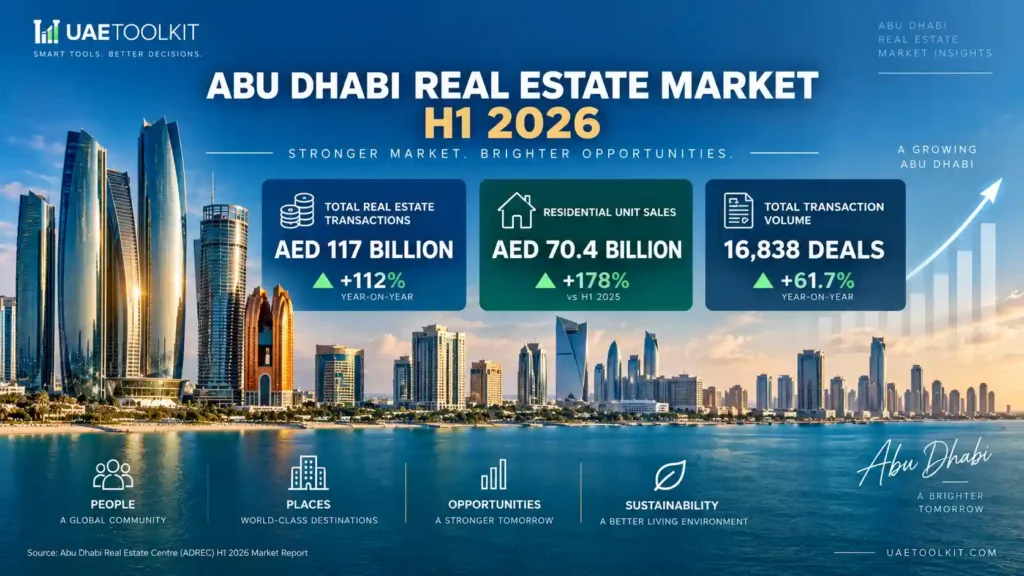
ADREC reported AED 117 billion in total real estate transactions during H1 2026, with transaction value increasing 112% year-on-year and transaction volume increasing 61.7%.
Sales transactions across the wider property market accounted for approximately AED 86.1 billion across 16,838 transactions during the period.
When looking specifically at residential units, sales reached AED 70.4 billion, compared with AED 25.3 billion during the first half of 2025.
That is a significant increase, but buyers should not interpret higher transaction values as proof that every property in Abu Dhabi has increased by the same amount.
Abu Dhabi contains very different submarkets.
A beachfront apartment on Saadiyat Island, an off-plan villa on Hudayriyat Island, a ready apartment on Al Reem Island and a townhouse in Zayed City can have completely different pricing, rental demand, service charges and investment characteristics.
For investors, community-level and property-level analysis matters more than emirate-wide headline growth.
Are Abu Dhabi Property Prices Increasing in 2026?
ADREC’s H1 2026 report provides an important indicator of price direction.
According to registered repeat-sales data, apartment prices increased 20% year-on-year while villa prices increased 12%.
Repeat-sales analysis is particularly useful because it looks at properties that have transacted more than once, rather than simply comparing today’s advertised listings with older asking prices.
However, these percentages should not be applied blindly to an individual property.
A buyer considering a particular unit should examine:
- Recent transactions in the same project or building
- Price per square foot
- Unit size and layout
- Floor and view
- Ready versus off-plan status
- Service charges
- Developer reputation
- Remaining payment obligations
- Comparable rental values
A market can rise overall while individual buildings or projects underperform.
What This Means for Buyers
Rising prices make it increasingly important to avoid buying based purely on statements such as “prices will go up” or “this is the next big area.”
Instead, ask a more useful question:
What am I paying compared with similar properties today?
For example, if two comparable apartments sell for AED 1,700 and AED 2,100 per square foot, the more expensive property needs a clear reason for its premium—perhaps a superior view, better location, stronger developer, larger layout or significantly better amenities.
Without that justification, market growth alone does not make the higher-priced property a good investment.
Off-Plan Property Is Dominating Abu Dhabi Sales
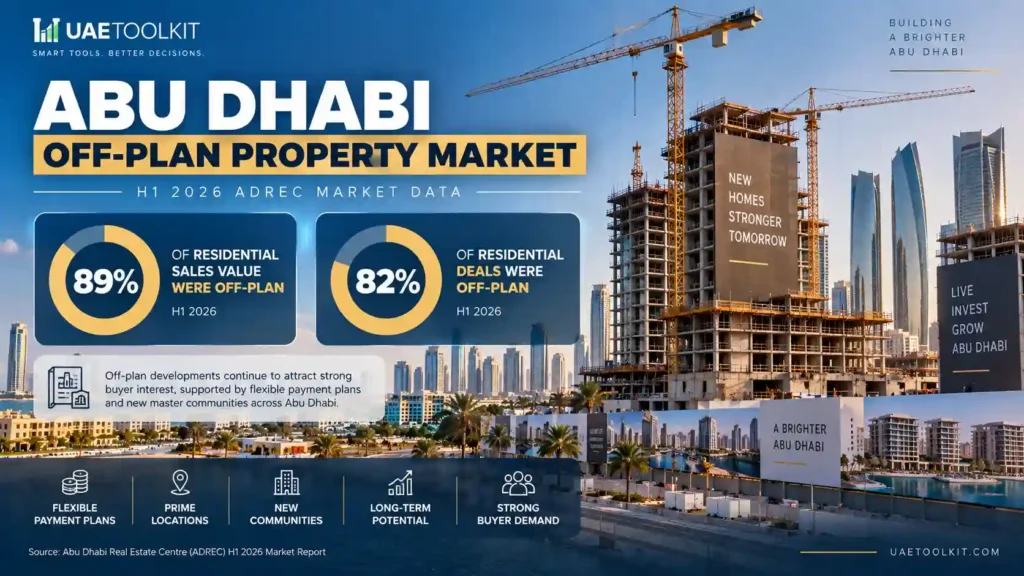
Perhaps the most important number in the entire H1 2026 report is 89%.
Off-plan transactions accounted for 89% of residential sales value and 82% of residential deals during H1 2026. ADREC also reported that the ten leading developers generated 90% of off-plan primary sales, representing AED 51 billion.
This tells us that a very large portion of current buying activity is directed toward properties that have not yet been completed.
That includes new masterplans, waterfront communities, luxury apartments, townhouses and villas being sold with multi-year payment schedules.
Why Are Buyers Choosing Off-Plan Property?
There are several possible attractions.
Off-plan projects can offer lower initial cash requirements than purchasing a completed property outright. Developers may provide structured payment plans that spread payments across construction and handover.
Buyers may also be trying to enter emerging communities before they are fully developed.
But off-plan investing introduces risks that do not exist in exactly the same way when purchasing a completed property.
These include construction timelines, future competing supply, changing market conditions, financing at handover and uncertainty about future rental performance.
A Practical Off-Plan Rule
Never evaluate an off-plan property using only:
Booking amount + monthly instalment.
Calculate the complete financial commitment instead:
Purchase price + registration-related costs + financing costs + other applicable acquisition expenses + future ownership costs.
Also check how much of the purchase price will become due at handover.
A payment plan can make an expensive property appear affordable during construction while leaving a substantial final payment several years later.
Which Abu Dhabi Areas Recorded the Most Residential Sales?

The H1 2026 data provides an interesting picture of where capital is flowing.
Hudayriyat Island recorded approximately AED 19 billion, representing 27% of residential sales value.
It was followed by:
Saadiyat Island — AED 13.3 billion
Al Reem Island + Al Maryah Island — AED 10.5 billion
Yas Island — AED 7.3 billion
These figures should not automatically be interpreted as a ranking of the “best” investment locations.
A high sales value can result from large project launches, expensive properties, strong transaction volumes—or a combination of these factors.
Hudayriyat Island
Hudayriyat’s AED 19 billion in residential sales demonstrates the scale of current development and buyer activity there.
For an investor, however, the important questions are what price is being paid today, what competing supply will arrive before handover, and what type of end-user or tenant demand the completed community can attract.
Saadiyat Island
Saadiyat continues to operate at the premium end of Abu Dhabi’s residential market, supported by beachfront communities, cultural destinations and luxury development.
Its investment case can therefore be different from a community chosen primarily for maximum rental yield.
Al Reem and Al Maryah Islands
These areas provide exposure to more established apartment markets and, depending on the property, existing rental demand.
Ready-property investors can also analyze actual rents and completed-building service charges rather than relying entirely on future projections.
Yas Island
Yas combines established residential communities with entertainment, tourism and continuing development.
As with every major Abu Dhabi investment area, the correct question is not simply whether Yas Island is good.
It is:
Which project, at what price, for what investment objective?
Foreign Buyers Are Playing a Major Role
International participation is another major feature of the Abu Dhabi property market in 2026.
Resident expatriates and non-resident foreign buyers together accounted for 70% of residential sales value during H1 2026. Emirati buyers committed approximately AED 21 billion, compared with AED 8.9 billion during H1 2025.
Separately, ADREC reported AED 13.8 billion in foreign direct investment during H1 2026, with non-resident investors from 116 nationalities participating in the market.
Abu Dhabi also had 50 approved investment zones after eight additional zones were approved during the first half of 2026.
For international investors, this creates a broader property market than Abu Dhabi offered historically.
But overseas buyers should still verify the ownership rules applicable to the specific property and investment zone rather than assuming the same structure applies everywhere in the emirate.
Abu Dhabi Rental Market in 2026
The rental market is another major part of the investment picture.
ADREC recorded approximately 233,000 active residential lease contracts during H1 2026 with a combined lease value of AED 9.3 billion.
Lease value increased 8% year-on-year while contract volumes increased 2%.
Rental growth was particularly notable for new leases.
ADREC reported that new-lease prices increased:
17% for apartments
9% for villas
Within investment zones, the increases were even higher:
21% for apartments
16% for villas.
This indicates considerable rental pressure, particularly in areas where investors are most active.
However, rising market rents do not mean every landlord can simply increase an existing tenant’s rent by the same percentage.
Important 2026 Abu Dhabi Rental Rule Update
In June 2026, the Abu Dhabi Government temporarily changed the annual rental increase percentage from 5% to 0% until further notice.
ADREC stated that residential, commercial and industrial tenancy renewals are to be processed at a 0% increase for the duration of the temporary measure.
This distinction matters.
Market rental growth describes what is happening to rental prices in the broader market.
The rental cap determines what may apply when dealing with tenancy agreements and renewals under the current regulatory framework.
Investors should therefore not take a market statistic showing rising new rents and automatically apply that increase to an existing tenancy.
Because the measure is temporary, landlords, tenants and prospective investors should verify the latest position with ADREC before making decisions based on the current rule.
Check the latest ADREC rental update
How Much Housing Supply Is Coming to Abu Dhabi?
Strong demand is only one side of the investment equation.
Supply matters too.
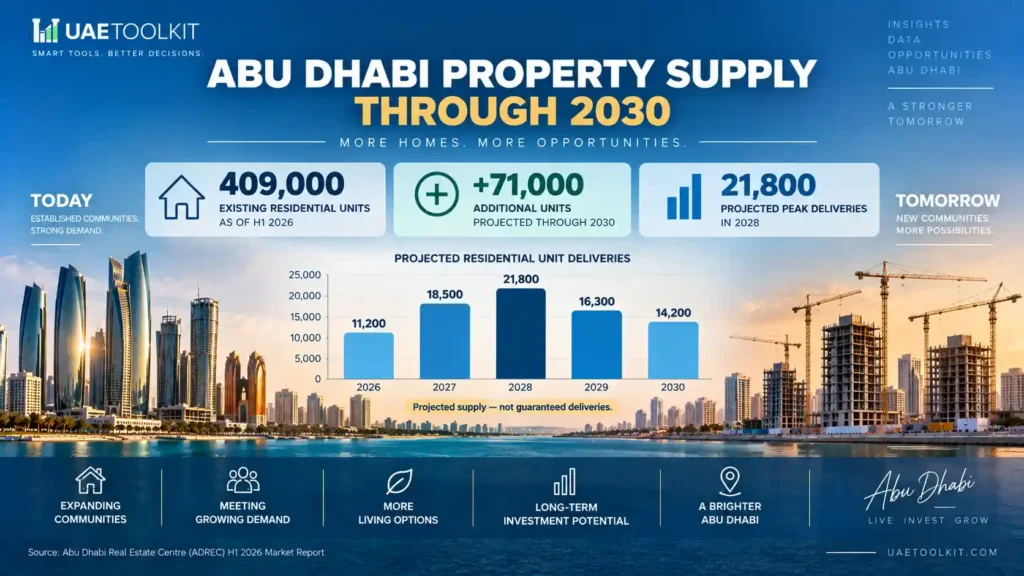
ADREC estimates that Abu Dhabi had approximately 409,000 residential units in H1 2026.
Around 71,000 additional units are projected through 2030, with annual deliveries expected to peak at approximately 21,800 units in 2028.
Six districts are expected to account for 77% of projected incremental supply through 2030:
Saadiyat Island, Al Reem Island, Yas Island, Zayed City, Khalifa City and Hudayriyat Island.
This is one of the most important statistics for long-term investors.
Why Future Supply Matters
Imagine buying an off-plan apartment scheduled for handover in 2028.
Your competition at handover may not be limited to today’s completed apartments.
You could also be competing against thousands of other units delivered around the same period.
That could affect:
Rental competition: More available apartments can give tenants greater choice.
Resale competition: Multiple owners may try to sell similar units simultaneously.
Price differentiation: Buildings with better locations, views, layouts, management or amenities may outperform less differentiated projects.
This does not mean increasing supply will automatically cause prices or rents to fall.
It means future supply should be part of the investment calculation.
Ready Property vs Off-Plan in Abu Dhabi
There is no universal winner.
Off-Plan May Suit Buyers Who:
Want to spread payments over the construction period, are comfortable waiting for completion, believe in the long-term potential of a particular project and have carefully assessed the handover obligation.
Ready Property May Suit Buyers Who:
Want immediate occupancy or rental income, prefer to inspect the actual property, want access to existing rental and service-charge data, or prefer an established community.
ADREC reports that 61% of ready-market purchases in H1 2026 were completed in cash.
For financed buyers, affordability should be evaluated using the actual mortgage structure rather than focusing only on the property’s advertised price.
Use the UAETOOLKIT Mortgage Calculator to estimate monthly payments before committing to a property.
How Investors Should Calculate Rental Yield
A property’s advertised rent is not its rental yield.
The basic gross-yield calculation is:
Annual Rent ÷ Property Purchase Price × 100
For example, suppose an investor purchases an apartment for:
AED 1,500,000
and receives:
AED 105,000 annual rent
The gross rental yield would be:
AED 105,000 ÷ AED 1,500,000 × 100 = 7%
But 7% is gross, not net.
An investor may still need to account for service charges, maintenance, property management, vacancy, financing costs and other applicable expenses.
That is why comparing two properties using rent alone can be misleading.
A property generating AED 150,000 in annual rent is not necessarily a better investment than one generating AED 100,000 if its acquisition and ownership costs are substantially higher.
Don’t Ignore Service Charges
Service charges can materially affect the return from an apartment investment.
Two properties with identical purchase prices and rents can produce different net returns if one building has significantly higher annual ownership costs.
Before buying, ask for the applicable service-charge information and calculate it against the property’s expected annual rent.
For investment analysis, focus on:
Gross rental income → less recurring property costs → estimated net income
rather than judging a property entirely by advertised gross yield.
This is particularly important in premium developments where extensive amenities may come with higher operating costs.
What About the UAE Golden Visa?
Property investment may also be relevant to buyers considering UAE residency.
However, Golden Visa eligibility should be treated separately from investment performance.
A property should not automatically be considered a good investment simply because it may contribute toward residency eligibility.
Buyers should verify the latest eligibility requirements with the relevant UAE authorities and confirm whether their specific ownership and financing structure qualifies.
Usman’s Market View
By Usman Bajwa, UAE Property Consultant & Founder of UAETOOLKIT
The biggest mistake I see buyers risk making in a fast-moving property market is focusing on the launch instead of the numbers behind the investment.
A project may have an attractive location, impressive renders and a convenient payment plan, but I still recommend asking four basic questions:
What am I paying per square foot?
What comparable properties are available today?
What realistic rent could this property achieve after completion?
How much competing supply may exist when I want to rent or resell it?
For off-plan buyers, I would add one more:
How much money will I need at handover?
The Abu Dhabi market’s H1 2026 performance is significant, but strong market growth does not eliminate the need to evaluate each property individually.
Is Abu Dhabi Real Estate Still Worth Investing In During 2026?
There are several positive indicators.
Residential sales activity has increased substantially. Foreign participation is strong. Rental demand remains significant. Major masterplans continue to attract capital, and Abu Dhabi’s investment-zone market has expanded.
But investors should also recognize the risks.
The market is heavily weighted toward off-plan sales, property prices have already experienced significant growth in parts of the market, and tens of thousands of additional homes are projected through 2030.
Therefore, the better conclusion is not:
“Abu Dhabi property will definitely go up.”
It is:
Abu Dhabi currently has strong market momentum, but investment performance will depend increasingly on selecting the right property at the right price.
What Could Affect the Abu Dhabi Property Market in 2027 and Beyond?
Several factors deserve attention.
The first is handover volume. As more projects reach completion, investors will be able to see whether rental and resale demand absorbs new supply effectively.
The second is off-plan concentration. With 89% of H1 2026 residential sales value coming from off-plan transactions, future performance will depend partly on successful project delivery and sustained buyer confidence.
The third is rental affordability. Abu Dhabi’s temporary 0% rental-increase measure demonstrates that housing costs are receiving regulatory attention.
Finally, investors should monitor financing conditions, population and employment growth, new investment zones, infrastructure development and the pace at which major masterplans become functioning communities.
Predicting an exact percentage for Abu Dhabi property-price growth in 2027 would be speculative.
A more useful approach is to monitor the underlying data as it changes.
Practical Checklist Before Buying Abu Dhabi Property
Before reserving a property, verify the developer and project status, understand whether the property is ready or off-plan, compare the price per square foot with relevant properties, estimate realistic rent, calculate gross and net yield, understand service charges, review the complete payment schedule, calculate the handover obligation, estimate mortgage payments if financing is required, understand registration and acquisition costs, review expected future supply in the area and verify applicable ownership and residency rules.
A good property decision should still make financial sense without relying on guaranteed capital appreciation.
Frequently Asked Questions
Is the Abu Dhabi real estate market growing in 2026?
Official ADREC data shows substantial growth in market activity. Residential unit sales reached AED 70.4 billion during H1 2026, compared with AED 25.3 billion in H1 2025. Repeat-sale prices were also up 20% year-on-year for apartments and 12% for villas.
Are Abu Dhabi property prices increasing?
At the market level, ADREC’s H1 2026 repeat-sales data indicates year-on-year increases of 20% for apartments and 12% for villas. Individual communities, projects and properties can perform differently.
Is off-plan property popular in Abu Dhabi?
Yes. Off-plan transactions accounted for 89% of residential sales value and 82% of residential deals during H1 2026.
Which Abu Dhabi area recorded the highest residential sales value?
Hudayriyat Island led H1 2026 with approximately AED 19 billion in residential sales value, followed by Saadiyat Island at AED 13.3 billion.
Are rents increasing in Abu Dhabi?
ADREC reported that new-lease prices increased 17% for apartments and 9% for villas. However, Abu Dhabi introduced a temporary 0% annual rental increase measure in June 2026, so market rental growth should not be confused with what can currently apply to tenancy renewals.
How many new properties are expected in Abu Dhabi?
ADREC projects approximately 71,000 additional residential units through 2030, with deliveries expected to peak at around 21,800 units in 2028.
Can foreigners buy property in Abu Dhabi?
Foreign investment is a significant part of the current market, with resident expatriates and non-resident foreign buyers accounting for 70% of residential sales value in H1 2026. Ownership rights depend on the applicable property and investment-zone framework, so buyers should verify the specific property before purchasing.
Official Sources & Methodology
The primary market statistics in this guide come from the Abu Dhabi Real Estate Centre (ADREC) H1 2026 Real Estate Market Report, which was published on August 18, 2026.
ADREC states that the report uses registered sales, lease and mortgage transactions and applies methodology including transaction filtering, price-range validation and geographic stratification. This distinction matters because registered transaction data should not be confused with property-portal asking prices.
ADREC — Abu Dhabi Real Estate Market Report H1 2026
ADREC — H1 2026 Transaction Report
Last updated: September 2026
UAETOOLKIT provides property research tools and educational information. Market conditions, regulations, fees and individual property performance can change. This guide does not constitute financial, legal or investment advice.
[…] guide uses registered-market information published by the Abu Dhabi Real Estate Centre (ADREC). ADREC states that its H1 2026 market findings are based on registered sales, lease and mortgage transactions, with methodologies […]