
How to Calculate Mortgage Payments in the UAE: A Simple Guide for Property Buyers
Knowing how to calculate mortgage payments in the UAE before you start property hunting is one of the smartest things you can do as a buyer. It takes five minutes, it’s free, and it can save you from falling in love with a property that quietly breaks your budget every month for the next 25 years.
Calculating mortgage payments in the UAE correctly from the start helps you avoid one of the most common and costly mistakes buyers make.
Yet most buyers skip this step entirely. They find a property they like, ask the agent “can I afford this?”, and only discover the real monthly cost when they’re already emotionally committed. By that point, walking away feels painful — even when the numbers don’t stack up.
This guide changes that. We’ll walk through exactly how UAE mortgage payments are calculated, what inputs actually matter, how different scenarios play out in real AED numbers, and what mistakes to avoid before you sign anything.
What Goes Into a UAE Mortgage Payment?
Before you can calculate mortgage payments in the UAE, you need to understand what a mortgage payment actually consists of.
Every monthly mortgage payment has two components:
Principal: This is the portion of your payment that reduces the actual loan balance. In the early years of a mortgage, this is a relatively small part of your payment. As the loan matures, more of each payment goes toward principal.
Interest: This is the bank’s charge for lending you the money. In the early years, this makes up the bulk of each payment. On a 25-year mortgage at 5%, roughly 60–70% of your early payments go toward interest rather than reducing your loan balance.
This is why the total amount you repay over a 25-year mortgage is significantly higher than the original loan amount — and why understanding the full cost matters just as much as knowing the monthly figure.
The Four Numbers That Determine Your Monthly Payment
To calculate mortgage payments in the UAE accurately, you need four inputs. Get these right and everything else follows.
1. Property Price
This is your starting point — the agreed purchase price of the apartment, villa, or townhouse you want to buy. The property price determines your down payment requirement and your maximum loan amount.
2. Down Payment
The down payment is the portion you pay from your own funds. In the UAE, the minimum down payment is regulated by the Central Bank:
- UAE nationals: 15% for properties up to AED 5 million
- Expat residents: 20% for properties up to AED 5 million
- Non-residents: 35% for ready properties
A higher down payment directly reduces your loan amount and therefore your monthly payment. It also strengthens your mortgage application.
3. Loan Amount
Your loan amount is simply:
Property Price − Down Payment = Loan Amount
For example: AED 1,500,000 − AED 300,000 = AED 1,200,000 loan
This is the amount the bank finances, and it’s what the interest is calculated on.
4. Interest Rate and Loan Tenure
The interest rate is what the bank charges for lending you money. In the UAE in 2026, typical mortgage rates range from 4.9% to 5.8% for expat residents on fixed-rate products.
The loan tenure is how many years you take to repay. The maximum is 25 years in most cases, subject to age limits (the mortgage must be fully repaid by age 65 for salaried employees).
Both of these significantly affect your monthly payment — a longer tenure means lower monthly payments but more total interest paid overall.
Real Examples: How to Calculate Mortgage Payments in the UAE
Let’s put the formula into practice with three real property price scenarios. All examples assume an expat resident buyer, 5% interest rate, 25-year tenure.
Example 1: AED 1,000,000 Property
| Property Price | AED 1,000,000 |
| Down Payment (20%) | AED 200,000 |
| Loan Amount | AED 800,000 |
| Interest Rate | 5% |
| Loan Tenure | 25 years |
| Estimated Monthly Payment | AED 4,678 |
| Total Interest Over 25 Years | AED 603,400 |
| Total Amount Repaid | AED 1,403,400 |
Salary needed (no other debts): Approximately AED 10,000–12,000 per month
Example 2: AED 1,500,000 Property
| Property Price | AED 1,500,000 |
| Down Payment (20%) | AED 300,000 |
| Loan Amount | AED 1,200,000 |
| Interest Rate | 5% |
| Loan Tenure | 25 years |
| Estimated Monthly Payment | AED 7,017 |
| Total Interest Over 25 Years | AED 905,100 |
| Total Amount Repaid | AED 2,105,100 |
Salary needed (no other debts): Approximately AED 15,000–18,000 per month
Example 3: AED 2,000,000 Property
| Property Price | AED 2,000,000 |
| Down Payment (20%) | AED 400,000 |
| Loan Amount | AED 1,600,000 |
| Interest Rate | 5% |
| Loan Tenure | 25 years |
| Estimated Monthly Payment | AED 9,356 |
| Total Interest Over 25 Years | AED 1,206,800 |
| Total Amount Repaid | AED 2,806,800 |
Salary needed (no other debts): Approximately AED 20,000–25,000 per month
This property also qualifies for the UAE Golden Visa — something worth factoring into your decision if long-term residency matters to you.
Use the UAE Mortgage Calculator to run your own scenarios with your exact property price, down payment, and interest rate.
How Interest Rate Changes Your Monthly Payment
One of the most important things buyers underestimate is how much the interest rate affects monthly payments. Even a 1% difference can add hundreds of dirhams per month over 25 years.
Here’s how different rates affect a AED 1,200,000 loan over 25 years:
| Interest Rate | Monthly Payment | Total Interest Paid |
|---|---|---|
| 4.5% | AED 6,658 | AED 797,400 |
| 5.0% | AED 7,017 | AED 905,100 |
| 5.5% | AED 7,388 | AED 1,016,400 |
| 6.0% | AED 7,731 | AED 1,119,300 |
| 6.5% | AED 8,107 | AED 1,232,100 |
The difference between a 4.5% rate and a 6.5% rate on the same loan is AED 1,449 per month — or AED 434,700 over the life of the loan. This is why shopping around for the best mortgage rate and getting multiple pre-approvals is worth the effort.
How Loan Tenure Changes Your Monthly Payment
The other big variable is loan tenure. A longer term reduces monthly payments but significantly increases total interest paid.
Here’s how tenure affects a AED 1,200,000 loan at 5% interest:
| Loan Tenure | Monthly Payment | Total Interest Paid |
|---|---|---|
| 10 years | AED 12,727 | AED 327,240 |
| 15 years | AED 9,490 | AED 508,200 |
| 20 years | AED 7,920 | AED 700,800 |
| 25 years | AED 7,017 | AED 905,100 |
Choosing a 25-year term over a 15-year term saves AED 2,473 per month — but costs an extra AED 396,900 in total interest. Whether that trade-off makes sense depends on your income, other financial goals, and how long you plan to hold the property.
Fixed Rate vs Variable Rate: Which Is Better?
When you apply for a mortgage in the UAE, the bank will offer you a choice between fixed-rate and variable-rate products. Understanding this before you calculate mortgage payments in the UAE matters because the rate type affects your future payment stability.
Fixed Rate Mortgage
Your interest rate is locked for an initial period — usually 1, 3, or 5 years. During this period, your monthly payment stays the same regardless of what happens to market interest rates.
After the fixed period ends, the mortgage reverts to a variable rate, which can go up or down. This is called the revert rate and is typically linked to EIBOR (Emirates Interbank Offered Rate) plus a margin set by the bank.
Most buyers in the UAE start with a fixed rate for peace of mind during the first few years of ownership. In 2026, fixed rates for expat residents typically range from 4.9% to 5.8% depending on the bank and loan size.
Variable Rate Mortgage
Your rate fluctuates with market conditions. If EIBOR rises, your payment rises. If EIBOR falls, your payment falls. Variable rates can sometimes be lower than fixed rates, but they come with uncertainty — especially over a 25-year term.
Before choosing, ask the bank:
- How long is the fixed period?
- What is the revert rate after the fixed period?
- Are there early settlement charges if I refinance?
- Can I make partial overpayments to reduce the principal faster?
The most foreigner-friendly banks for UAE mortgages in 2026 include Emirates NBD, HSBC UAE, First Abu Dhabi Bank, Mashreq, and Dubai Islamic Bank. Each has slightly different rate structures and eligibility requirements — it’s worth comparing at least two or three before committing.
The Real Cost of Buying: Monthly Payment Is Just One Part
This is where many buyers get caught out. They calculate the monthly mortgage payment, decide it’s affordable, and then discover a wall of additional costs they hadn’t factored in.
Here’s the full picture for a AED 1,500,000 property purchase in Dubai with a mortgage:
Upfront costs (paid before or at transfer):
| Cost | Amount |
|---|---|
| Down Payment (20%) | AED 300,000 |
| DLD Transfer Fee (4%) | AED 60,000 |
| Property Registration Fee | AED 4,200 |
| Mortgage Registration (0.25% of loan) | AED 3,000 |
| Property Valuation | AED 3,000 |
| Agent Commission (2% + VAT) | AED 31,500 |
| Bank Processing Fee (~1%) | AED 12,000 |
| Total Cash Needed at Purchase | AED 413,700 |
Ongoing annual costs (after purchase):
| Cost | Estimated Amount |
|---|---|
| Service Charges | AED 15,000–35,000 per year |
| Building Insurance | AED 1,000–3,000 per year |
| Maintenance | AED 2,000–5,000 per year |
The monthly mortgage payment is AED 7,017 — but the true annual cost of ownership includes service charges, insurance, and maintenance on top of that.
Use the Property Buying Cost Calculator to get a full upfront cost estimate, the DLD/ADM Fee Calculator for transfer fees, and the Service Charge Calculator for annual ownership costs.
How the DBR Rule Affects Your Mortgage Calculation
When you calculate mortgage payments in the UAE, you also need to understand whether your salary can actually support the payment — because the bank will check this rigorously.
The Central Bank of the UAE caps your total monthly debt repayments at 50% of gross monthly income. This is called the Debt Burden Ratio (DBR).
The formula is:
(Monthly Salary × 50%) − Existing Monthly Debts = Maximum Mortgage Payment
Example: You earn AED 20,000 per month and have a car loan of AED 2,000.
- 50% of AED 20,000 = AED 10,000
- Minus car loan: AED 10,000 − AED 2,000 = AED 8,000
- Your maximum monthly mortgage payment = AED 8,000
At 5% interest over 25 years, AED 8,000 per month supports a loan of approximately AED 1,368,000 — enough for a property around AED 1,710,000 with a 20% down payment.
For a full salary-to-mortgage eligibility breakdown, see our guide on Salary Required for Mortgage in UAE.
5 Mistakes to Avoid When Calculating UAE Mortgage Payments
Mistake 1: Using only the best case interest rate
Don’t calculate affordability at 4.5% if the bank quotes you 5.5%. Always test your numbers at the actual rate you’re likely to receive — and then test what happens if it rises by 1% after the fixed period ends.
Mistake 2: Forgetting existing debts
Your car loan, personal loan, and credit card obligations all count toward your DBR. Ignoring them gives you an inflated picture of your mortgage capacity.
Mistake 3: Not including upfront costs
DLD fees, agent commission, mortgage registration, and valuation fees add 6–8% to your total cash requirement on top of the down payment. Budget for all of it before committing.
Mistake 4: Borrowing the maximum the bank offers
Just because the bank approves you for a certain amount doesn’t mean you should use all of it. Leave breathing room for service charges, emergencies, school fees, and the occasional interest rate rise.
Mistake 5: Skipping mortgage pre-approval
Calculating the payment yourself is a good starting point. But only a bank pre-approval tells you what you’re actually eligible for. Get pre-approved before making an offer on any property — it protects you and makes you a more credible buyer.
Step-by-Step: How to Calculate Your UAE Mortgage Payment
Here is the simplest step-by-step process to calculate mortgage payments in the UAE accurately before speaking to any bank.
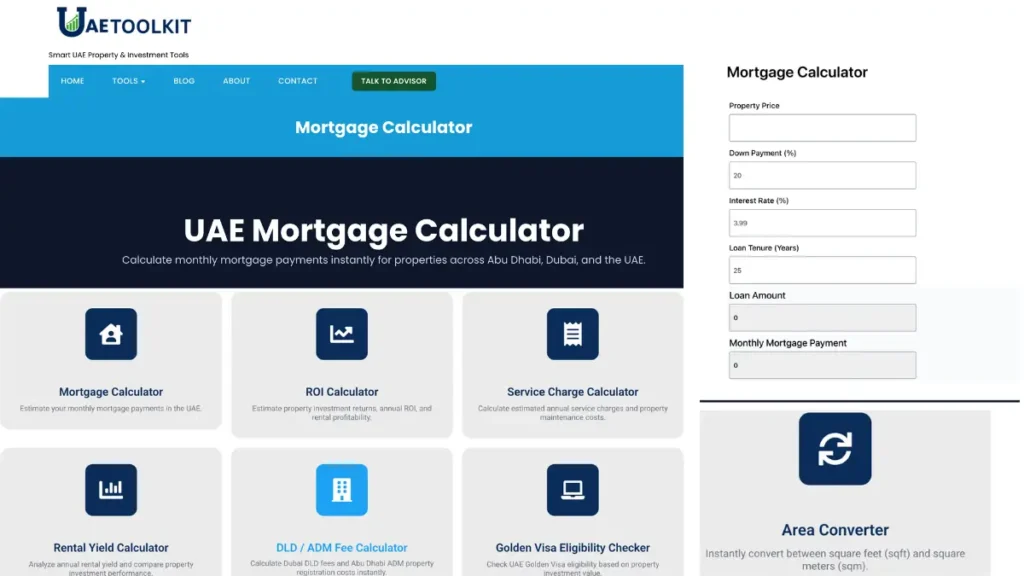
Here’s the simple process to follow:
Step 1: Decide on a property price you’re considering
Step 2: Calculate your down payment (20% for expat residents on properties under AED 5M)
Step 3: Subtract the down payment from the property price to get your loan amount
Step 4: Enter the loan amount, interest rate (use 5–5.5% as a realistic estimate), and loan tenure (25 years maximum) into the UAE Mortgage Calculator
Step 5: Check the monthly payment against your DBR (your salary × 50%, minus existing debts)
Step 6: Add the upfront costs — DLD fee, registration, agent commission, mortgage fees
Step 7: If everything fits comfortably, get mortgage pre-approval from a bank before making an offer
Frequently Asked Questions
The easiest way to calculate mortgage payments in the UAE is to use the free UAE Mortgage Calculator which does this instantly.
How do I calculate mortgage payments in UAE? The monthly mortgage payment depends on your loan amount, interest rate, and loan tenure. The formula is: Monthly Payment = Loan Amount × [r(1+r)^n] / [(1+r)^n−1], where r is the monthly interest rate and n is the number of months. The easiest way is to use the UAE Mortgage Calculator which does this instantly.
What is the typical mortgage interest rate in UAE in 2026? For expat residents in 2026, fixed mortgage rates typically range from 4.9% to 5.8% for an initial fixed period of 1 to 5 years. After the fixed period, the rate reverts to a variable rate linked to EIBOR plus a bank margin. Non-residents typically pay 0.5% to 1% more.
Does the UAE mortgage calculator include all fees? A basic mortgage calculator estimates your monthly principal and interest payment. It does not include DLD transfer fees, agent commission, mortgage registration fees, valuation costs, or service charges. Use the Property Buying Cost Calculator for the full cost picture.
Can I reduce my monthly mortgage payment? Yes — in three ways. First, increase your down payment to reduce the loan amount. Second, choose a longer loan tenure (up to 25 years). Third, negotiate a lower interest rate by comparing multiple banks or using a mortgage broker.
What is the maximum mortgage term in UAE? The maximum mortgage term is 25 years, subject to age limits. The mortgage must be fully repaid by age 65 for salaried employees and age 70 for self-employed applicants. A 45-year-old can therefore take a maximum 20-year mortgage.
Should I get mortgage pre-approval before looking at properties in UAE? Yes — always. Pre-approval tells you exactly how much the bank will lend you and at what rate. This gives you a real budget before you start property hunting, prevents you from wasting time on properties outside your range, and makes you a more credible buyer when negotiating with sellers.
Can non-residents get a mortgage in UAE? Yes, some banks offer mortgages to non-resident buyers. However, the terms are stricter: minimum 35% down payment, lower maximum LTV of 65%, higher interest rates, and more documentation required. Many non-resident investors choose to pay cash or use developer payment plans instead.
Is a longer or shorter mortgage term better in UAE? It depends on your situation. A longer term (25 years) reduces monthly payments but increases total interest paid. A shorter term (15 years) increases monthly payments but saves significantly on total interest. If your income comfortably supports it, a shorter term with occasional overpayments is often the smarter long-term financial choice.
All figures in this guide are estimates based on 2026 market rates and CBUAE regulations. Final mortgage terms, interest rates, fees, and approval decisions are made by individual banks. Always confirm your specific figures with a licensed UAE bank or mortgage advisor before making any property purchase decision.
Ready to run your numbers? Use the free UAE Mortgage Calculator to estimate your monthly payment in seconds.