
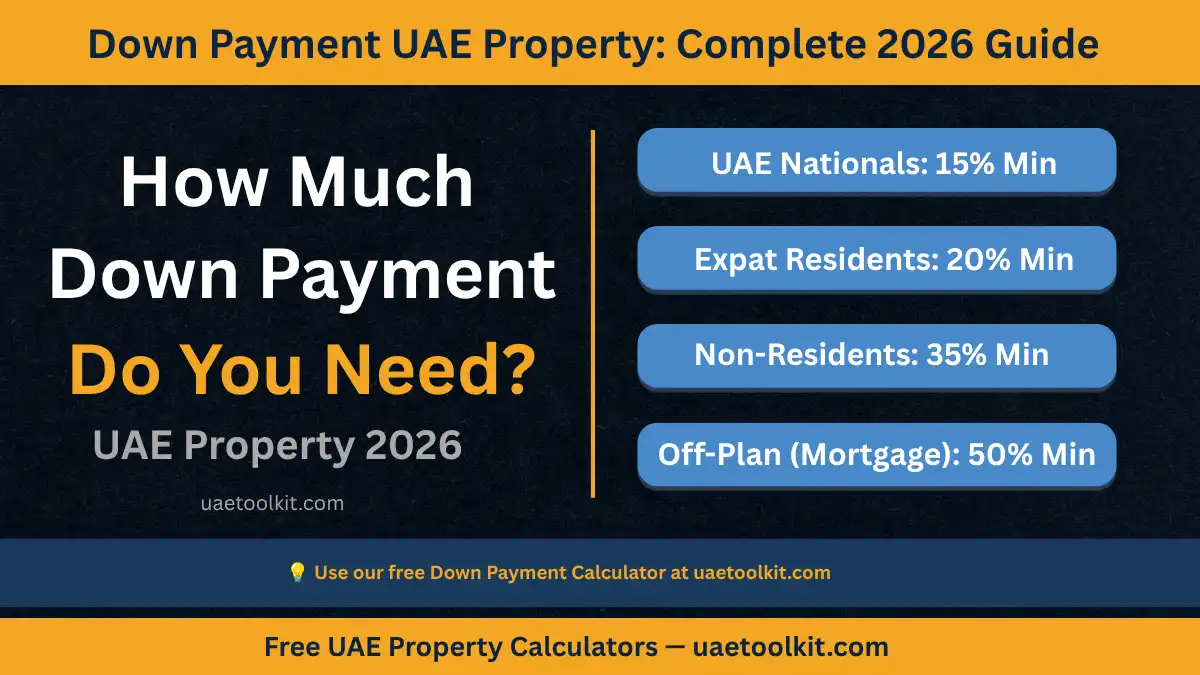
Down Payment UAE Property: How Much Do You Need? (2026 Guide)
Down payment UAE property rules are one of the most misunderstood parts of buying real estate here — and getting them wrong can leave you short by AED 130,000 or more on closing day.
Most people hear “20% down payment” and stop there. They save up 20% of the property price, feel ready, and then get a nasty surprise when they realize the actual cash they need is significantly higher. On a AED 2,000,000 apartment, budgeting only AED 400,000 (20%) can leave you short by AED 130,000 or more once all the upfront costs are factored in.
This guide gives you the complete picture — the exact down payment percentages based on who you are, what you’re buying, and how much it costs, plus all the additional fees that come on top.
Who Sets the Down Payment Rules in UAE?
Before we get into the numbers, it’s worth understanding where these rules come from.
Down payment requirements in the UAE are not set by individual banks — they’re regulated by the Central Bank of the UAE (CBUAE) under Circular 31/2013. Every licensed mortgage lender in the country must follow these rules. No bank can legally offer you a higher loan-to-value ratio than the CBUAE caps, no matter how strong your income or credit history.
What this means for you: the minimum down payment figures in this guide are fixed by law. They are not negotiable starting points. Individual banks can require more than the minimum based on their own risk assessment, but they cannot go below it.
Down Payment by Buyer Type: The Exact Numbers
Your minimum down payment depends on three things: your residency status, the property value, and whether you’re buying a ready or off-plan property.
UAE Nationals — First Property
UAE nationals get the most favourable mortgage terms in the market:
| Property Value | Maximum LTV | Minimum Down Payment |
|---|---|---|
| Up to AED 5,000,000 | 85% | 15% |
| Above AED 5,000,000 | 75% | 25% |
On a AED 1,500,000 property, a UAE national needs a minimum of AED 225,000 as a down payment.
Expat Residents — First Property
Resident expats with a valid UAE visa and Emirates ID fall under this category:
| Property Value | Maximum LTV | Minimum Down Payment |
|---|---|---|
| Up to AED 5,000,000 | 80% | 20% |
| Above AED 5,000,000 | 70% | 30% |
On a AED 1,500,000 property, an expat resident needs a minimum of AED 300,000 as a down payment. On a AED 6,000,000 property, that jumps to AED 1,800,000 — a meaningful difference that catches many buyers off guard when they cross the AED 5 million threshold.
Non-Resident Foreign Buyers
If you live outside the UAE and are buying as an overseas investor, lenders treat you as a higher-risk borrower:
| Property Value | Maximum LTV | Minimum Down Payment |
|---|---|---|
| Ready properties | 65% | 35% |
| Off-plan properties | Mostly cash | Up to 50%+ |
Most UAE banks do not finance off-plan purchases for non-residents at all. For ready properties, expect to put down at least 35% — and some banks require 40% to 50% depending on your profile. Non-residents also pay higher interest rates, typically 0.5% to 1% more than resident expats.
Second Property or Investment Property
If this isn’t your first UAE property, the rules change regardless of your nationality:
| Buyer Type | Maximum LTV | Minimum Down Payment |
|---|---|---|
| UAE nationals (2nd property) | 65% | 35% |
| Expat residents (2nd property) | 60% | 40% |
Off-Plan Properties — All Buyers
This is where many buyers are surprised. If you’re buying an off-plan property using a bank mortgage, the CBUAE requires a minimum down payment of 50% of the property value — regardless of your nationality or residency status.
However, most off-plan buyers don’t use a mortgage during the construction phase. Instead, they follow the developer’s payment plan, which spreads payments across the construction period. A typical off-plan payment structure looks like this:
- Booking fee: 5–10% (locks in your unit)
- Oqood registration: 4% (DLD registration fee, paid within 30 days)
- Construction instalments: 40–60% (spread over the build period)
- Handover payment: 10–40% (paid when the property is ready)
Many major developers like Emaar, Sobha, and DAMAC use an 80/20 plan — you pay 80% during construction and 20% at handover. If you want to finance that final 20% with a mortgage, you arrange it once the property is complete and a title deed is ready.
The Real Number: Total Cash You Need at Closing
Here’s the part most guides skip — and the part that catches buyers off guard.
The down payment is not the total cash you need. On top of your down payment, you must pay several additional costs entirely in cash. Since February 2025, DLD fees and agency commissions cannot be rolled into your mortgage — they must come from your own pocket.
Here’s a realistic cash-to-close breakdown for an expat resident buying a ready AED 2,000,000 apartment with a mortgage:
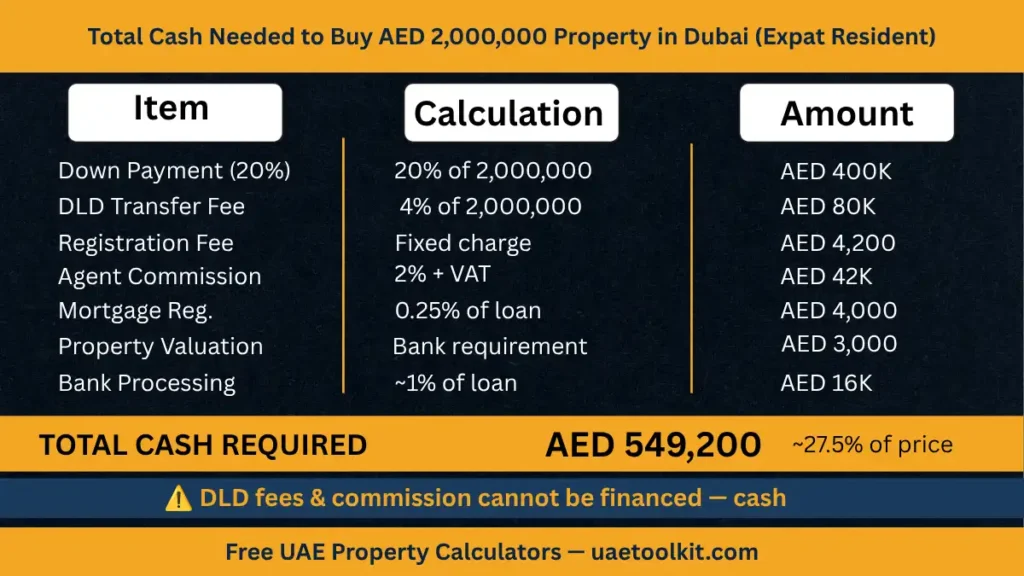
That’s AED 549,200 in total upfront cash — not AED 400,000. The fees add roughly AED 149,000 on top of the down payment alone. Anyone who tells you to budget only the 20% down payment is giving you an incomplete picture.
Use the Down Payment Calculator and Property Buying Cost Calculator to get the exact figures for your specific property price.
The AED 5 Million Threshold: Why It Matters
One of the most important numbers to know as a buyer is AED 5,000,000. It’s the point at which the LTV rules change — and the impact on your down payment is dramatic.
Let’s say you’re an expat resident looking at two properties:
| Property Price | LTV | Down Payment |
|---|---|---|
| AED 4,900,000 | 80% | AED 980,000 (20%) |
| AED 5,100,000 | 70% | AED 1,530,000 (30%) |
Crossing the AED 5 million threshold by just AED 200,000 increases your down payment by AED 550,000. This is why many buyers in the AED 4.5 to AED 5.5 million range carefully consider which side of the threshold they want to be on.
How Much Can You Actually Borrow?
Your down payment determines how much the bank lends you, but your income determines how much the bank is willing to lend. The CBUAE caps your total monthly debt repayments — including the mortgage — at 50% of your gross monthly income. Some banks set this even lower at 40–45%.
This is called the Debt Burden Ratio (DBR). Here’s how it works in practice:
If you earn AED 30,000 per month, your maximum total monthly debt repayments cannot exceed AED 15,000 (50%). If you already have a car loan of AED 3,000 per month, your maximum mortgage payment drops to AED 12,000 per month.
At current interest rates of roughly 4.9% to 5.8% for a 25-year term, AED 12,000 per month supports a loan of approximately AED 1,800,000 to AED 2,000,000.
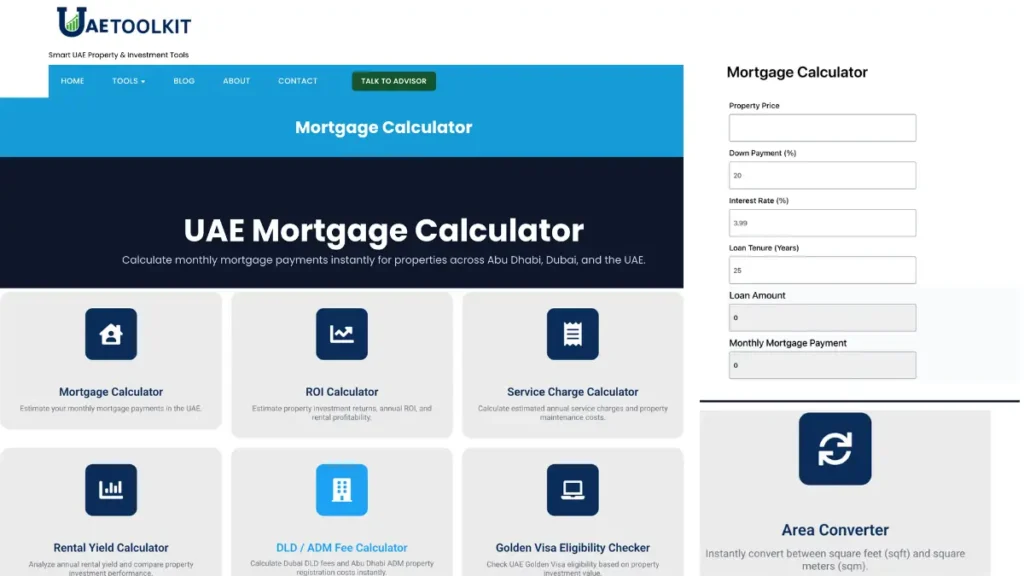
Use the Mortgage Calculator to see exactly what monthly payment different loan amounts would require.
Where Your Down Payment Money Must Come From
UAE banks are strict about the source of your down payment funds. Not all money is accepted equally.
Accepted sources:
- Personal savings in a UAE or international bank account (3–6 months of statements required)
- Equity released from another UAE property you own
- Documented gifts from immediate family members (requires a signed gift letter)
- Proceeds from a property sale
Not accepted:
- Personal loans or credit card advances (banks check your credit report — if they see borrowed funds, they will decline your mortgage)
- Business loans or company funds (must be clearly personal income)
- Undocumented cash (anti-money laundering rules require all funds to be traceable)
This is important: if you’re planning to save your down payment, start at least 6 months before you plan to buy so you have clear bank statements showing the funds building up over time.
Mortgage Interest Rates in UAE (2026)
Knowing the down payment is only part of the picture. The interest rate determines your monthly cost over the life of the loan.
As of 2026, typical mortgage rates in the UAE are:
| Buyer Type | Fixed Rate (1–5 years) | Variable Rate |
|---|---|---|
| Expat residents | 4.9% – 5.8% | 4.25% – 5.5% |
| UAE nationals | 4.5% – 5.5% | 4.0% – 5.0% |
| Non-residents | 5.5% – 6.5% | 5.0% – 6.0% |
Most buyers start with a fixed rate for the first 1–5 years for predictability, then move to a variable rate. The fixed period locks in your payment — useful when you’re settling into a new property and adjusting your budget.
The most foreigner-friendly banks for mortgages in the UAE currently include Emirates NBD, HSBC UAE, First Abu Dhabi Bank (FAB), Mashreq Bank, and Dubai Islamic Bank. Each has slightly different eligibility criteria and rates — it’s worth getting pre-approval from more than one lender to compare.
Down Payment and the Golden Visa: The Connection
Here’s something that many buyers don’t realize: since February 2026, your down payment alone can qualify you for the UAE Golden Visa — even on a mortgaged property.
Previously, Golden Visa eligibility through property required you to have paid at least AED 1,000,000 upfront. That rule has been removed. Now, eligibility is based entirely on the certified value of the property — not how much you’ve paid.
What this means in practice: if you buy a property worth AED 2,000,000 and put down the standard 20% (AED 400,000), you qualify for the Golden Visa even with AED 1,600,000 still outstanding on your mortgage.
Example:
- Property value: AED 2,200,000
- Down payment (20%): AED 440,000
- Fees (approx. 6%): AED 132,000
- Total cash needed: AED 572,000
- Result: 10-year UAE Golden Visa eligibility
For buyers targeting the Golden Visa, the AED 2 million property threshold is the key number to aim for. See our full UAE Golden Visa Through Property Guide for the complete application process.
Tips to Reduce How Much You Need Upfront
Buy off-plan with a developer payment plan: Instead of a large upfront down payment, spread your payments across the construction period. This is how many first-time buyers enter the market without having the full 20% plus fees saved up.
Look for developer fee absorption promotions: Many developers — especially on new launches — offer to pay the DLD fee on your behalf. On a AED 2 million property, that saves you AED 80,000 immediately.
Consider properties just below AED 5 million: If you’re looking at higher-value properties, staying below AED 5 million keeps your LTV at 80% rather than 70%, reducing your required down payment significantly.
Improve your DBR before applying: Pay down existing loans and credit cards before applying for a mortgage. A lower debt burden ratio means the bank can lend you more, which reduces the gap your down payment needs to cover.
Get mortgage pre-approval first: Know exactly how much a bank will lend you before you start property hunting. This gives you a realistic budget and makes you a more serious buyer in negotiations.
Down Payment UAE Property: Quick Reference Summary Table
| Buyer Type | Property Value | Min. Down Payment | Total Cash Needed (Est.) |
|---|---|---|---|
| UAE National | Up to AED 5M | 15% | ~21–22% of property price |
| UAE National | Above AED 5M | 25% | ~31–32% of property price |
| Expat Resident | Up to AED 5M | 20% | ~26–28% of property price |
| Expat Resident | Above AED 5M | 30% | ~36–38% of property price |
| Non-Resident | Ready property | 35% | ~41–43% of property price |
| Any buyer | Off-plan (mortgage) | 50% | ~56–58% of property price |
| Any buyer | 2nd property (expat) | 40% | ~46–48% of property price |
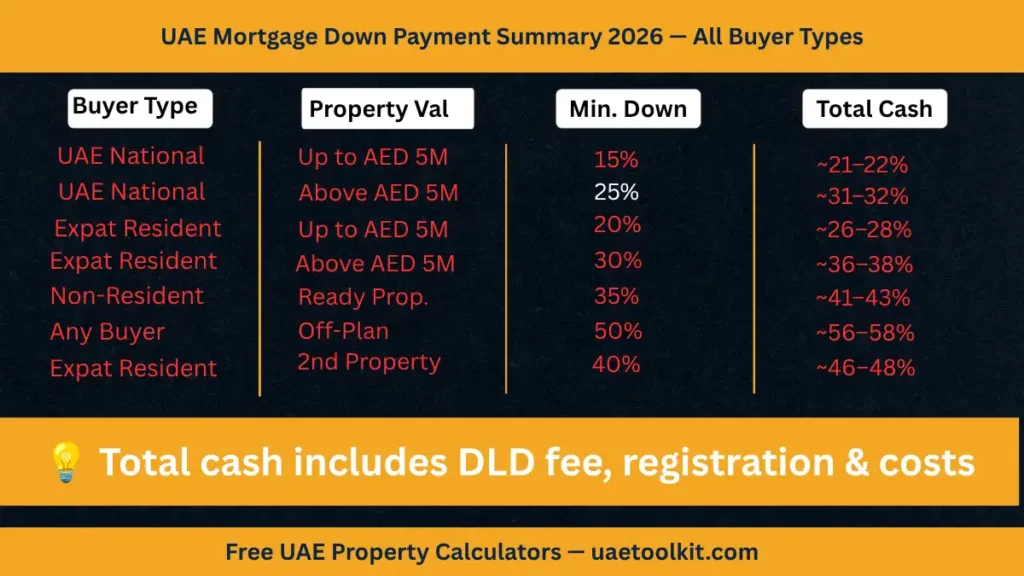
Estimates include DLD transfer fee, registration, agent commission, and mortgage costs. Use the Property Buying Cost Calculator for your exact figures.
Frequently Asked Questions
How much down payment do I need to buy property in UAE as an expat? As an expat resident, the minimum down payment is 20% for properties valued up to AED 5 million. For properties above AED 5 million, the minimum rises to 30%. On top of the down payment, budget an additional 6–8% of the property price for fees including DLD transfer fee, registration, agent commission, and mortgage costs.
Can I buy property in UAE with no down payment? No. UAE law mandates a minimum down payment for all mortgage-financed purchases. The lowest minimum is 15% for UAE nationals on properties up to AED 5 million. There is no zero-down-payment mortgage available in the UAE.
How much down payment does a non-resident need in UAE? Non-residents need a minimum of 35% for ready properties. Off-plan purchases are generally not mortgaged by UAE banks for non-residents, so most overseas investors buying off-plan do so on developer payment plans or with cash.
Can I use a personal loan for my down payment in UAE? No. UAE banks specifically check whether your down payment funds were borrowed. If they find evidence of a personal loan used as a down payment, your mortgage application will be declined. The funds must come from personal savings, property equity, or documented family gifts.
Does the down payment count toward Golden Visa eligibility? Since February 2026, Golden Visa eligibility is based on the total certified value of the property, not the amount paid. A 20% down payment on a AED 2 million property qualifies you for the Golden Visa even with the remaining 80% under a mortgage.
What is the minimum salary to get a mortgage in UAE? Most major banks require a minimum monthly salary of AED 15,000 for expat applicants. Your total monthly debt repayments, including the mortgage, cannot exceed 50% of your gross monthly income under CBUAE regulations.
How long does mortgage approval take in UAE? Pre-approval typically takes 3–7 working days. Full mortgage approval after property selection takes 2–4 weeks depending on the bank and documentation completeness.
What is the maximum mortgage term in UAE? The maximum mortgage term is 25 years for most buyers, subject to age limits. The mortgage must be fully repaid by age 65 for salaried employees or age 70 for self-employed individuals. A 40-year-old expat can therefore take a maximum term of 25 years, but a 50-year-old is limited to 15 years.
All figures in this guide are based on CBUAE regulations and market data as of 2026. Mortgage rates and bank policies change — always get a formal pre-approval from a licensed UAE lender before making any property purchase decision.
Ready to calculate your numbers? Use our free Down Payment Calculator or Mortgage Calculator to see exactly what you need for your specific situation.