
Can a Foreigner Buy Property in UAE? Complete 2026 Guide
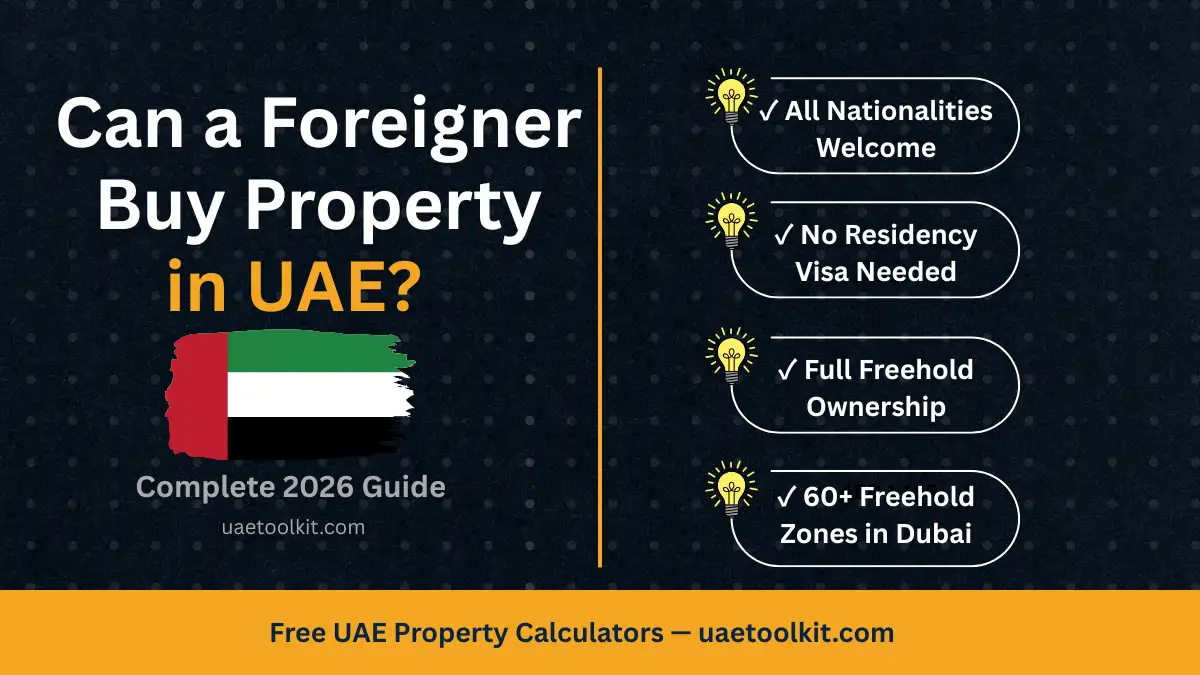
Can a foreigner buy property in UAE? The answer is yes — and in 2026, it is more straightforward than ever. Foreign buyers get full freehold ownership in designated areas: your name on the title deed, the right to sell or rent whenever you want, and no time limit on how long you can hold the property.
That said, there are rules. You can’t buy just anywhere. The UAE operates a zone-based system where foreign ownership is permitted in specific designated areas, and restricted everywhere else. Understanding this system before you start searching for properties will save you a lot of confusion — and possibly a very expensive mistake.
This guide covers everything a foreign buyer needs to know about purchasing property in the UAE in 2026: where you can buy, what ownership actually means, how the buying process works, what it costs, and what residency benefits come with it.
Can a Foreigner Buy Property in UAE? The Legal Answer
Foreigners have been allowed to purchase property in the UAE since Dubai passed its landmark Freehold Law in 2002, opening up specific areas of the emirate to international buyers for the first time. Before that, property ownership in the UAE was largely restricted to UAE and GCC nationals.
That law changed everything. It attracted billions of dirhams in foreign capital, transformed Dubai into one of the world’s most international property markets, and eventually influenced other emirates to follow with their own versions of foreign ownership laws.
Today, in 2026, the rules are well established and well enforced. Foreigners can buy property in the UAE — but only within government-approved freehold zones (in Dubai) or designated investment zones (in Abu Dhabi and other emirates). Outside these zones, properties are still restricted to UAE and GCC nationals.
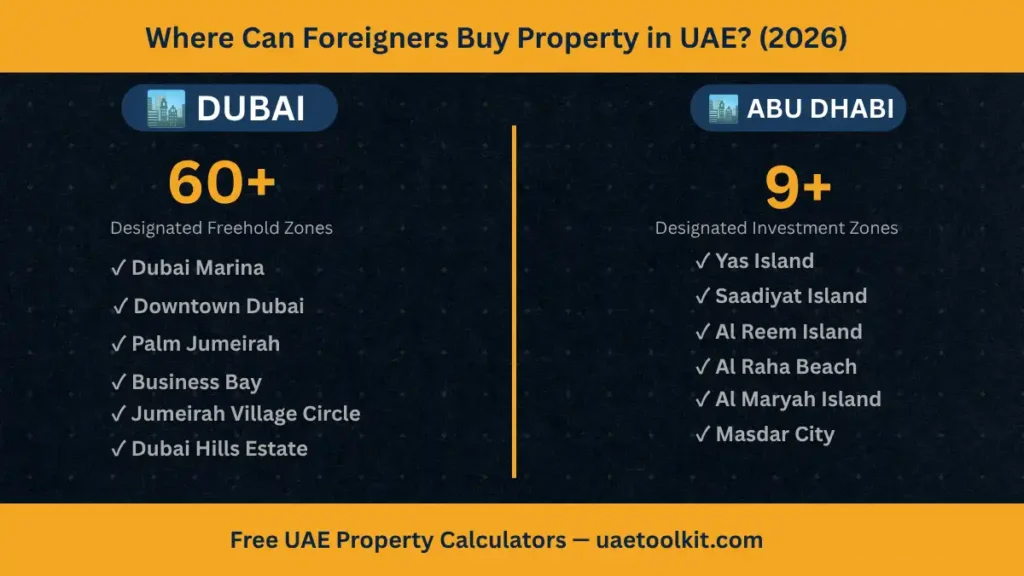
This isn’t as limiting as it sounds. In Dubai alone, there are now over 60 designated freehold areas covering the city’s most desirable communities. In Abu Dhabi, the list of investment zones includes some of the most sought-after addresses in the emirate. For most international buyers, the available options are more than sufficient.
What “Freehold Ownership” Actually Means
When you buy property in a UAE freehold zone as a foreigner, you get the same ownership rights as a UAE national in that area. Specifically:
- Your name goes on the official title deed, registered with the Dubai Land Department (in Dubai) or ADREC (in Abu Dhabi)
- You can sell the property at any time, to anyone, without restrictions
- You can lease it out and keep the rental income
- You can mortgage it through a UAE bank
- You can gift it or pass it to your heirs
- There is no expiry date on your ownership
This is genuine ownership — not a long-term lease dressed up as ownership. When people talk about buying property in Dubai or Abu Dhabi, this is what they mean.
Three Types of Ownership: Freehold, Leasehold, and Usufruct
Not every property in a designated zone comes with freehold title. It’s worth understanding the three types before you buy:
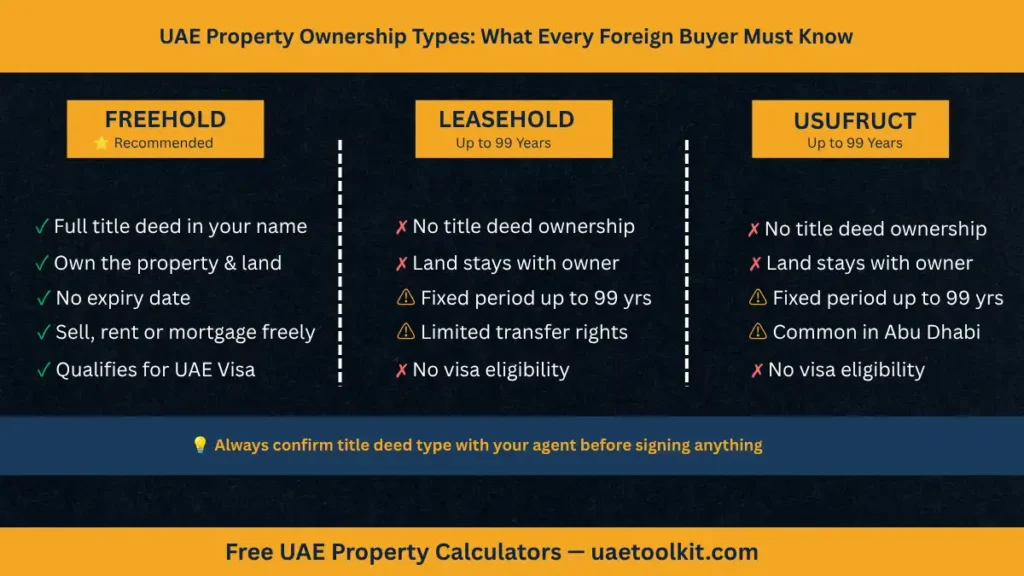
Freehold: Full ownership of the property and the land it sits on, registered permanently in your name. You can sell, rent, mortgage, or inherit it without restriction and without time limits. This is what most foreign buyers are looking for.
Leasehold: The right to occupy and use the property for a fixed period — typically up to 99 years. You don’t own the underlying land. At the end of the lease, ownership reverts to the landowner. This type of arrangement is more common in older developments or areas where full freehold rights aren’t available.
Usufruct: Similar to leasehold — you get the right to use and benefit from the property for up to 99 years, but without owning the land. More common in Abu Dhabi and in certain older community developments.
For most international buyers in 2026, freehold is the clear choice. It provides the strongest ownership rights and is the basis for visa eligibility — leasehold and usufruct arrangements generally don’t qualify you for UAE residency visas.
Where Can Foreigners Buy in Dubai?
Dubai offers the broadest access for foreign buyers of any emirate. As of 2026, there are over 60 designated freehold areas where foreigners can purchase property with full ownership rights.
The most popular and actively traded zones include:
Waterfront and luxury: Dubai Marina, Palm Jumeirah, Jumeirah Beach Residence (JBR), Bluewaters Island, Emaar Beachfront
City center: Downtown Dubai, Business Bay, DIFC
Family communities: Dubai Hills Estate, Arabian Ranches, Jumeirah Village Circle (JVC), Jumeirah Village Triangle (JVT), Al Furjan, Town Square
Emerging areas: Dubai South, Dubai Creek Harbour, Meydan, Sobha Hartland, Mohammed Bin Rashid City
There are no nationality restrictions in freehold areas — buyers from India, the UK, Pakistan, Russia, China, Europe, the US, or anywhere else can buy freely. There are no quotas on how many units in a building can be owned by non-UAE nationals, and there’s no cap on the number of properties a single foreign buyer can own.
One important rule to remember: popular older neighborhoods like Deira, Al Karama, Bur Dubai, and Oud Metha are not freehold zones. Foreign buyers cannot purchase property in these areas with full ownership rights. Always confirm a property’s zone status before proceeding.
Where Can Foreigners Buy in Abu Dhabi?
Abu Dhabi opened up to foreign buyers later than Dubai, with the major reform coming through Law No. 19 of 2005 and a significant expansion in 2019. Today, foreigners can purchase freehold property in designated investment zones — but roughly 40% of Abu Dhabi’s residential areas remain restricted to UAE and GCC nationals.
The main investment zones where foreigners can buy in Abu Dhabi include:
- Yas Island — entertainment, leisure, family living
- Saadiyat Island — cultural district, luxury villas, high-end residences
- Al Reem Island — urban living, popular with professionals and expats
- Al Raha Beach — waterfront community, mix of apartments and villas
- Al Maryah Island — financial and commercial hub
- Masdar City — sustainable development community
- Al Reef — affordable community, popular with families
Most new projects launched in Abu Dhabi since 2019 by major developers like Aldar, Miral, and Modon are fully freehold. However, some older developments may offer usufruct or musataha rights instead — always confirm the title deed type before buying.
Other Emirates: Ras Al Khaimah, Sharjah, and Beyond
Dubai and Abu Dhabi get most of the attention, but other emirates have also opened up to foreign buyers:
Ras Al Khaimah: Marjan Island is the main freehold destination, offering waterfront properties and resort-style living. RAK is increasingly popular with investors looking for lower entry prices and strong rental yields, particularly with the arrival of Wynn Resorts’ casino development attracting significant attention.
Sharjah: Has expanded its freehold offerings in recent years, with areas like Aljada, Tilal City, and Al Mamzar now available to foreign buyers. Sharjah offers lower prices than Dubai and appeals to buyers looking for affordability within commuting distance of Dubai.
Umm Al Quwain: An emerging option with freehold zones including Siniyah Island and Umm Al Quwain Marina Freehold Zone.
Do You Need a UAE Visa or Residency to Buy?
No — and this is one of the most important things to know.
You do not need a UAE residence visa to purchase property. You do not need to be a UAE resident. You can buy property in a UAE freehold zone even if you’re visiting on a tourist visa. Many international investors purchase UAE properties without ever intending to live there, managing their investment remotely from abroad.
What you do need:
- A valid passport (this is your primary identity document for the transaction)
- Proof of funds or mortgage pre-approval (for financing)
- A signed sale agreement
You do not need a local tax ID, a UAE bank account (though having one makes transactions smoother), or a local sponsor of any kind.
If you can’t be physically present to complete the transaction, a notarized Power of Attorney allows someone to sign on your behalf and complete the purchase process.
Can You Get a Mortgage as a Foreign Buyer?
Yes — UAE banks offer mortgages to both residents and non-residents. However, the terms differ depending on your situation.
For UAE residents: Standard mortgage terms apply. Most banks will lend up to 75–80% of the property value for a first property purchase, with a minimum 20–25% down payment.
For non-resident foreign buyers: Mortgages are available but with some additional requirements. You’ll typically face:
- A higher minimum down payment (often 25–40% depending on the bank)
- More documentation requirements (proof of income from your home country, bank statements, employer letters)
- Fewer lender options compared to residents
Some international buyers choose to pay cash to avoid the complexity of arranging cross-border financing. Others use mortgages from their home country’s banks (if the bank accepts UAE property as security) to fund the purchase.
Use the Mortgage Calculator to estimate your monthly repayments, and the Down Payment Calculator to figure out how much you’ll need upfront.
What Does It Cost to Buy as a Foreigner?
Good news: the fees are exactly the same for foreign buyers as for UAE nationals. There is no foreign buyer surcharge or additional government levy on international purchasers.
Here’s what you’ll pay on top of the property price:
In Dubai:
- DLD Transfer Fee: 4% of property price
- Property Registration Fee: AED 4,200
- Title Deed: AED 580
- Agent commission (if applicable): 2% + 5% VAT
In Abu Dhabi:
- DMT Registration Fee: 2% of property price
- Title Deed: AED 1,000
- Agent commission (if applicable): 2% + 5% VAT
For a full breakdown of every fee you’ll pay, see the Property Buying Cost Calculator or read our detailed guide on How Much Does It Cost to Buy Property in UAE.
There is no annual property tax in the UAE. There is no capital gains tax on residential property sales for individuals. And there is no income tax on rental income. Once you’ve paid the upfront buying costs, your ongoing government obligations are minimal.
What Visa Do You Get When You Buy Property in UAE?
This is where buying UAE property becomes particularly attractive for international investors. Property ownership can qualify you for UAE residency — and there are three different visa tiers depending on your investment level:
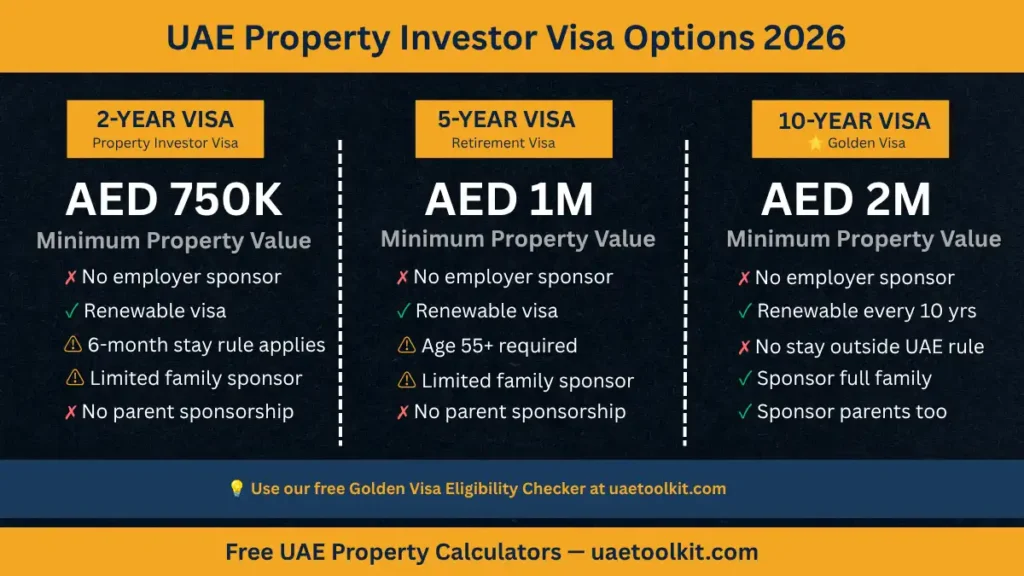
2-Year Property Investor Visa (from AED 750,000): Available to sole owners of completed residential properties in Dubai valued at AED 750,000 or more. As of April 2026, sole owners of any completed residential property in Dubai can qualify with no minimum value — though the AED 750,000 threshold applies for the standard investor visa in some contexts. This shorter visa has a standard 6-month stay-outside-UAE rule.
5-Year Retirement Visa (from AED 1,000,000): Available to buyers aged 55 and above who own property worth AED 1 million or more, or who meet certain financial criteria alongside property ownership.
10-Year Golden Visa (from AED 2,000,000): The most valuable option. Property worth AED 2 million or more (based on DLD-certified market value) qualifies you for a 10-year renewable residency. No employer sponsor needed. No restriction on time spent outside the UAE. Full family sponsorship including spouse, children, and parents.
For a complete breakdown of the Golden Visa route, see our UAE Golden Visa Through Property: Complete 2026 Guide.
Step-by-Step: How the Buying Process Works
Once you’ve found a property and agreed on a price, here’s how the purchase process typically flows:
Step 1 — Sign the MOU (Form F): The Memorandum of Understanding is the sale agreement signed between buyer and seller. It confirms the price, payment terms, and conditions. You’ll pay a deposit at this stage — typically 10% of the purchase price.
Step 2 — Apply for the Developer NOC: The developer issues a No Objection Certificate confirming there are no outstanding service charges or disputes on the property. Usually takes 5–7 working days and costs AED 500 to AED 5,000 (typically paid by the seller).
Step 3 — Transfer at the DLD Trustee Office: Both buyer and seller (or their representatives) appear at a DLD-approved trustee office. The transfer fee and other charges are paid, and ownership is formally transferred.
Step 4 — Receive Your Title Deed: The Dubai Land Department issues the title deed in your name — either as a physical document or a digital e-Title Deed. You are now the official registered owner.
For off-plan properties, the process differs slightly: you sign a Sales and Purchase Agreement (SPA) directly with the developer, payments are made to an escrow account protected by RERA regulations, and the title deed (or Oqood certificate) is issued upon registration.
Common Mistakes Foreign Buyers Make
Buying outside a freehold zone: The most expensive mistake of all. Always verify that the specific property you’re buying is within a designated freehold area before signing anything.
Assuming the purchase price is the total cost: Factor in the DLD transfer fee, registration fees, agent commission, and mortgage costs. On a AED 2 million property, you could easily spend AED 140,000 to AED 180,000 in additional costs.
Not registering a will: UAE inheritance law defaults to Sharia principles for unregistered estates. Expat buyers should register a will through the DIFC Wills Service Centre to ensure their property passes to their chosen heirs according to their wishes.
Ignoring service charges: Annual service charges apply to most communities and buildings. In Dubai, these range from AED 12 to AED 35 per square foot per year. On a 1,200 sq ft apartment, that’s AED 14,400 to AED 42,000 every year. Always check the service charge rate before you buy. Use our Service Charge Calculator to estimate your annual cost.
Skipping due diligence on off-plan developers: Not all developers are equal. Check the developer’s track record, project registration with RERA, and escrow account status before committing to an off-plan purchase.
Frequently Asked Questions
Can a foreigner buy property in UAE without a residency visa? Yes. You do not need UAE residency or a visa to purchase property. A valid passport is sufficient. Many international investors buy UAE property while living in another country entirely.
Can I buy property in UAE on a tourist visa? Yes. There is no visa requirement linked to the right to purchase property in designated freehold zones. Tourist visa holders can legally complete a property purchase.
Is there a minimum purchase price for foreigners? No minimum purchase price exists for freehold property ownership itself. However, residency visa eligibility has thresholds — AED 750,000 for the 2-year investor visa and AED 2,000,000 for the 10-year Golden Visa.
Can I buy property in UAE without visiting in person? Yes. With a notarized Power of Attorney, a representative can complete the entire purchase process on your behalf. Many overseas investors buy UAE properties remotely without ever visiting.
Is there property tax in UAE? No. There is no annual property tax in the UAE for residential property owners. There is also no capital gains tax on residential property sales for individuals, and no income tax on rental income.
Can I rent out my UAE property as a foreigner? Yes. As a freehold property owner, you can rent your property on both long-term and short-term (holiday home) bases. Short-term rentals in Dubai require a DTCM (Dubai Tourism) holiday home permit.
What happens to my UAE property when I die? Without a registered will, UAE law defaults to Sharia inheritance principles for distributing assets. Foreign buyers should register a will with the DIFC Wills Service Centre to ensure their property is distributed according to their own wishes.
Can foreigners buy commercial property in UAE? Yes. Commercial properties including offices, retail spaces, and warehouses located in freehold zones can be purchased by foreign nationals under the same rules as residential property.
All information in this guide reflects UAE regulations as of 2026. Property laws and zone designations can change — always confirm current rules with the Dubai Land Department, ADREC, or a licensed UAE real estate agent before completing any transaction.
Ready to calculate your costs? Use our free Property Buying Cost Calculator or get in touch for guidance on your specific situation.
[…] signal, not just a tourism headline. Analysts covering the island describe it as fundamentally a capital growth market rather than a yield play, with buyers driven by limited beachfront land, world-class […]